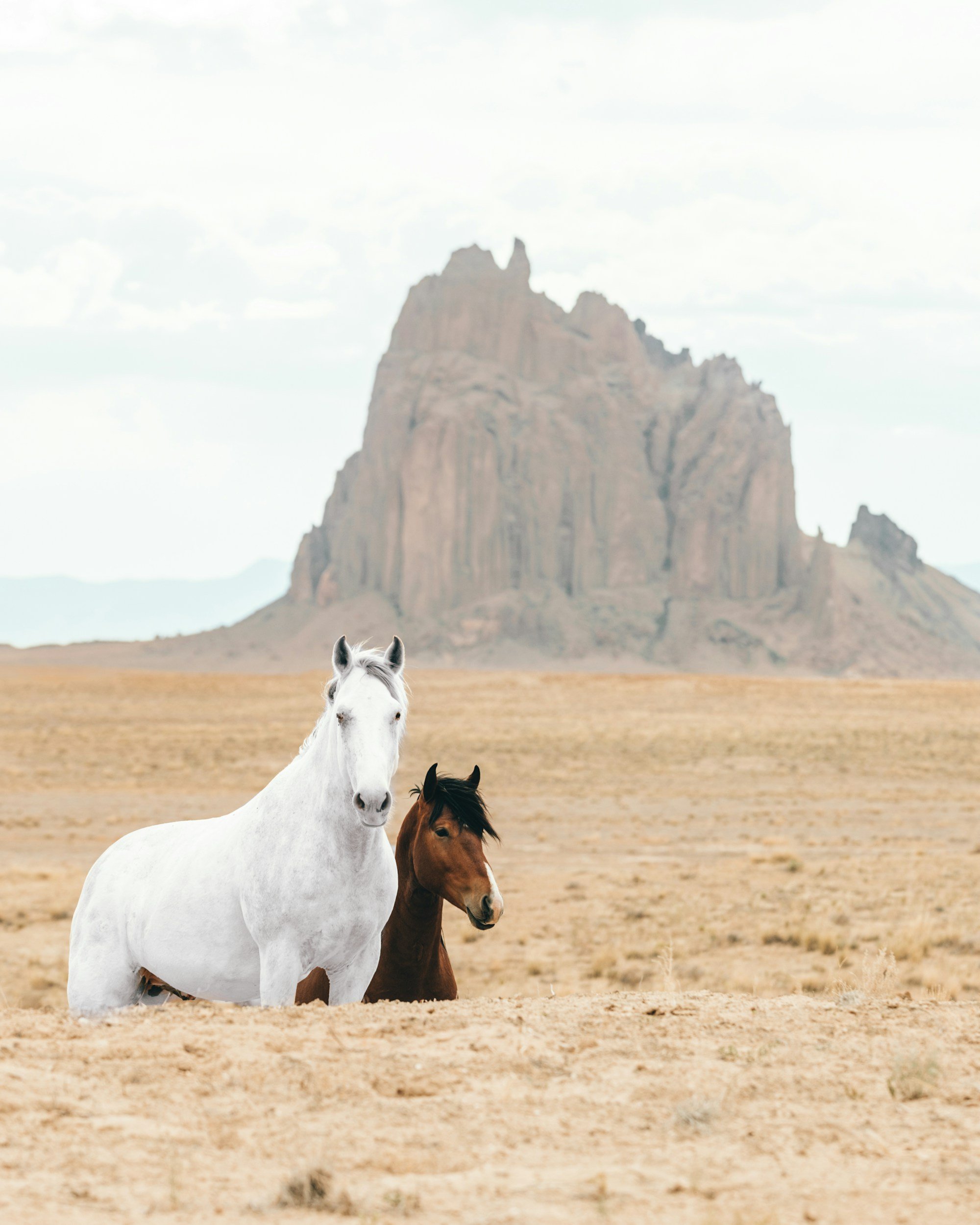

Yes, horses can live in the desert, and a few wild herds have been doing it for about a hundred years. The catch is water. A horse handles dry heat better than you’d guess, but it can’t get far from a drink for long, and nearly every desert horse story that ends badly ends at a dry waterhole.
It’s Jack here, and I’ll be straight with y’all. I went into this figuring desert horses had to be some special model, built different from the ones at the barn. The research says otherwise, and that surprised me.
So let’s look at why dry heat isn’t the real enemy, what the water bill looks like, how far wild horses will walk for a drink, which breeds came out of hot, dry country, and what to change if your own horse lives somewhere like that.
Dry Heat Is the Easy Part

A horse cools off mostly by sweating. The sweat sits on the skin, evaporates, and takes the heat with it. That only works if the air has room for the moisture. In muggy air a horse can sweat buckets and barely cool down at all.
Extension folks use a quick rule of thumb for this: add the temperature in Fahrenheit to the relative humidity. Clemson says a horse cools best under 130. Between 130 and 150 it starts losing ground, and over 150 its cooling is greatly reduced. The University of Georgia adds that 180 and up may be fatal.
Now run the numbers on two afternoons.
A 90-degree day at 70% humidity, which is a plain old Southeast summer, comes to 160. A 105-degree desert day at 10% humidity comes to 115.
By that math, the desert day is the easier one. Turns out that’s not as crazy as it sounds, because bone-dry air pulls sweat off a horse in a hurry.
I wouldn’t take 115 as a green light to saddle up at 3 p.m., though. The index doesn’t count the sun, it’s a rough guide, and it says nothing about the part that comes next.
The Water Bill Comes Due

All that fast sweating has to be paid for. An average horse doing nothing much drinks 10 to 12 gallons a day, says the Extension’s horse team, and hot, humid weather can easily double it. RSPCA Australia puts a 500 kg horse, about 1,100 pounds, at 30 to 50 liters a day, and says that can run higher in the heat.
Work is where it gets serious. The University of Georgia figures a horse working hard in a hot place can lose 2 to 4 gallons of sweat an hour. Three hours at the high end is a whole day’s drinking, gone.
That’s why a desert horse isn’t really fighting heat. It’s fighting distance, because the grass and the water are rarely in the same spot. A horse out there spends its life walking between the two.
How Far Wild Horses Walk for a Drink

Researchers in Australia put GPS collars on 12 feral horses in the outback and followed them for 6.5 days. Those horses averaged 15.9 km a day, close to 10 miles, and the biggest day ran 28.3 km, about 18 miles. Some were recorded as far as 55 km from water. That’s around 34 miles. A few walked 12 hours straight from their feed to a drink.
And they didn’t drink every day. The average gap between drinks was about 2.67 days, anywhere from 1 to 4.
The horses in central Australia walked long, straight lines to patchy feed, while the ones in Queensland could graze close to water and didn’t need to. Same animal, different map. If you want to see how the rest of wild horse life works, I wrote about how horses survive in the wild a while back.
Compare all that to a gelding in a small pasture with a trough at the gate. The authors said these distances were far beyond what had been seen in managed domestic horses.
The Namib Horses Aren’t Superhorses

The most famous desert horses on earth live near Aus, in Namibia, around a waterhole at Garub. They came from the horses of the old Kubub stud farm. Africa Geographic says they visit the water every two to three days, depending on the weather and how close the grazing is. Reports have them going about 30 hours without water in summer and close to 72 hours in winter, with 15 to 20 km (9 to 12 miles) between water and the best grazing.
You’d think that makes them a different animal. Here’s the surprise. A 1993 study found their water-saving ability didn’t differ from other horses when they were dehydrated for up to 60 hours. It did leave the door open for a difference past 72 hours, but nobody’s waving that around as proof of a superhorse.
Dr. Telané Greyling, who spent decades watching them, concluded the change was in how they behave, and in living with some dehydration, more than in their genes.
Honestly, I find that encouraging and a little sobering at the same time. A desert horse is mostly an ordinary horse that learned the routine. It also means there’s no secret tank in there when the water quits.
Mustangs Do It Closer to Home

You don’t have to fly to Africa to see this. Utah State University Extension says more than 70,000 feral horses live on federal lands in the West, and about half of them are in Nevada. That’s sagebrush and high desert, hot in summer and hard in winter, and those herds move between the springs and the feed the same way.
The same Extension write-up says a horse needs 7 to 14 gallons of water a day depending on the season, and that horses can dominate a water source and push smaller animals off it. In a dry year there’s only so much spring to go around.
Their feet tell the same story. All that walking on rock and gravel is why wild horses don’t need horseshoes, though your own horse may be a different case, so ask your farrier.
The Breeds That Came Out of Dry Country

Three breeds get named the most, and each has real history in hot, dry places.
The Arabian comes from the Arabian Peninsula, where Bedouin breeders kept a tight line through a hard desert life. Nobody can say exactly where or when it started, and plenty of the early story is legend. Its fans will tell you all about it, and if you’re choosing between Arabians and something fancier, here’s my take on the Andalusian vs the Arabian.
The Akhal-Teke comes from Turkmenistan, on the edge of the Karakum desert. Back in 1935 a group of riders left Ashgabat for Moscow, roughly 4,300 km, about 2,670 miles, and got there in 84 days. The Karakum leg was around 225 miles in three days with very little water, though the tellings differ on the details.
The Barb comes from North Africa, the Maghreb, and it’s known for hardiness and stamina. Some accounts tie that toughness to pasture slowly turning into the Sahara around it.
Here’s where I’ll take a side. Breed helps, sure. But I’d rather have a fit, used-to-it grade horse with a full trough than a fancy desert breed and a dry one. Don’t buy a pedigree and skip the water plan.
When the Desert Wins

I don’t want to make this sound easy, because it isn’t.
In May 2018, near Cameron, Arizona, on the western edge of the Navajo Nation, dead horses were found around a stock pond that had dried up. Reports said nearly 200, and a tribal count later that week found 118 horses and two cows. Either way, the Navajo Nation’s vice president put it plainly: “These animals were searching for water to stay alive.”
In January 2019, around two dozen wild horses were found dead at a dried-up spot called Deep Hole, near Santa Teresa in central Australia, during a run of days above 42°C, about 108°F.
Even the Namib herd has had terrible years. Africa Geographic reports it fell from 286 horses to just 74, with drought and hyenas working together. Between 2013 and 2018, not one foal survived.
If Your Horse Lives Somewhere Hot and Dry


Plenty of folks keep happy horses in Arizona, Nevada and West Texas. They just plan around the water. Here’s what I’d have in place at the barn.
- Water all day, every day. RSPCA Australia says clean water 24 hours a day, with more on offer than the horse needs. I’d want a second trough too, in case one fails.
- Shade that moves with the sun. Trees, a building or a shade cloth all count. Georgia’s team also suggests turnout in the cooler hours, early morning or overnight.
- Feed off the ground. Merck’s vet manual says horses swallow sand when they’re kept or fed in sandy areas, and that drought can hit several at once. A rack or a rubber mat helps. Weight loss, diarrhea or colic on sandy ground means a call to your vet.
- A fit horse. Out-of-shape and overweight horses are at higher risk of heat stress, so bring a new arrival along slowly.
- Eyes on the sweat. Pouring sweat is a warning sign. So is no sweat at all on a hot day. If your horse has quit sweating, that’s a vet call today.
Salt and electrolytes are a question for your vet too, since the right answer depends on your horse and its work. And if you’re wondering how this compares with the opposite extreme, here’s whether horses can live in the jungle.
Horses are tougher than we give them credit for. They’ll take the heat. Just keep the water where they can reach it, and they’ll take care of the rest. Happy trails, y’all.