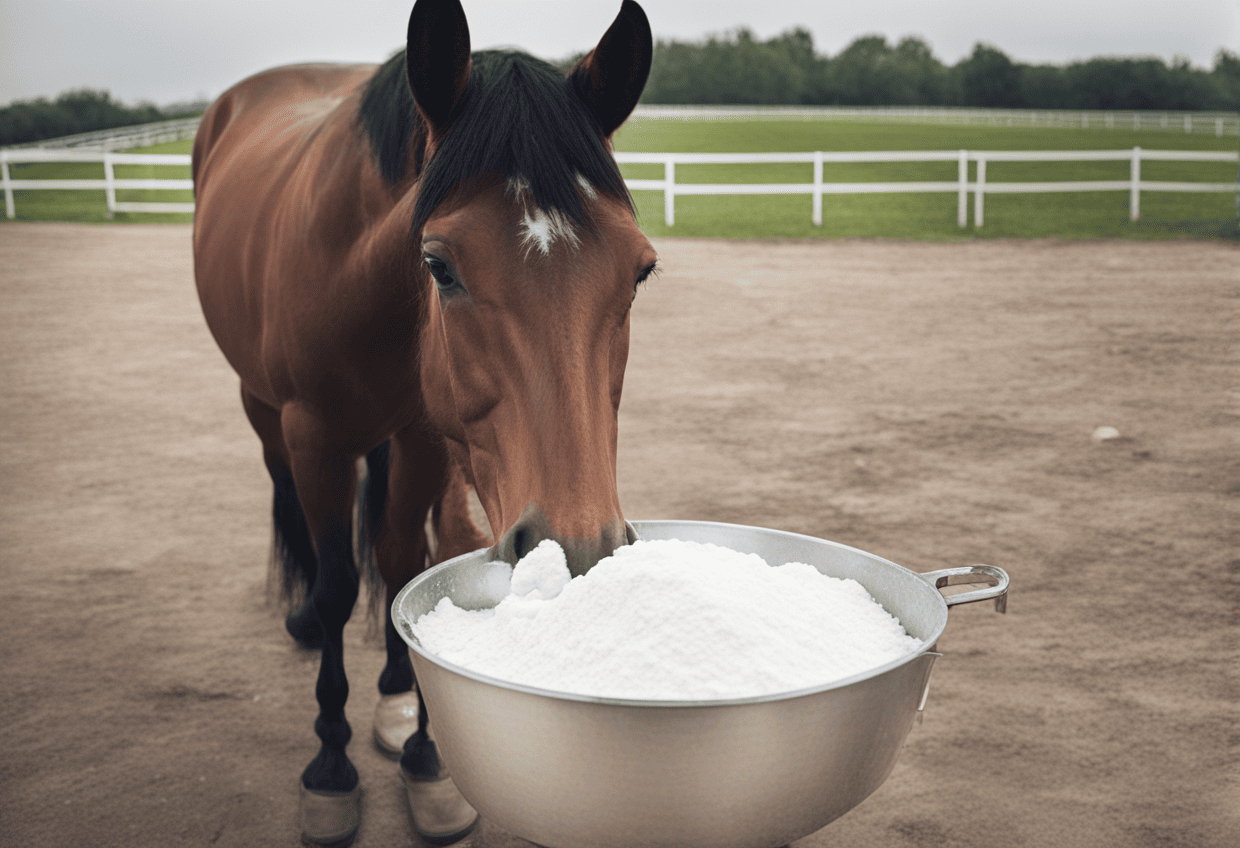
Hey y’all, it’s Jack here. You want to know how much baking soda to feed your horse, so you get the honest answer first. It just isn’t the one the feed-store chatter gives you.
The vet-school studies don’t give a daily amount of baking soda for a healthy horse, and I’m not going to make one up. Here’s what the studies do show. An antacid’s effect in a horse’s stomach lasts 2 hours at most. In controlled trials, baking soda didn’t help trained racehorses run any better. And the smallest dose in an Ohio State study (about half a cup for a 1,000 lb horse) threw the mares’ blood chemistry off for at least 8 hours. So “how much” is your vet’s call, and for plenty of horses the answer is none.

What Does Baking Soda Do for Horses?
Baking soda is sodium bicarbonate. It’s an antacid, so when it meets acid, it neutralizes it. That part’s just chemistry. The real question is how long that lasts inside your horse, and where the stuff ends up.
In the stomach? Not long. The European College of Equine Internal Medicine put out a consensus statement on stomach ulcers in 2015. On antacids, it says “their effect is short-lived (≤2 hours) and their use as a sole therapeutic agent is not justified.” Two hours. That’s it, out of a 24-hour day.
Further down the gut, Kansas State University tested it on 9 horses fitted with a port into the cecum, the big fermenting pouch in the hindgut where a grain overload turns things acidic. Six of them got 1.0 g of baking soda per kg of body weight through a stomach tube. For a 1,000 lb horse, that’s about a pound of it.
Their cecum pH did go up, and it stayed up for the whole 36-hour study. But those horses also drank more water and their blood went too alkaline. Their blood sodium climbed. Their potassium dropped. The researchers were looking at a way to treat horses after a grain overload, not at a daily topping for the feed tub.
And the old racetrack trick? Some trainers tube a big dose of baking soda into a horse before a race (folks call it a “milkshake”), hoping it boosts stamina. A 2020 review pooled 7 controlled trials with 74 horses. Given 2.5 to 5 hours before a treadmill test or a practice race, it made no difference to how they ran. Giving it within 24 hours of a race is banned in most of the racing world anyway.

Is It Safe to Give My Horse Baking Soda?
Bigger amounts sure aren’t harmless, and trouble starts sooner than most folks think.
At Ohio State’s vet school, researchers gave 6 Standardbred mares baking soda in 3 liters of water. There were 3 doses by mouth: 250, 1,000 and 1,500 mg per kg of body weight. The mares had no feed or water while they were watched for 12 hours. Every one of those doses did the same four things for at least 8 hours. It made the blood too alkaline. It pushed blood sodium up. It pulled potassium down. And it made the blood more concentrated (hyperosmolality, if your vet uses the big word).
The smallest dose, 250 mg per kg, works out to about 113 g for a 1,000 lb horse. USDA’s food data puts a teaspoon of baking soda at 4.6 g. So that’s roughly 8 tablespoons, or half a cup.
Now here’s the part that bugged me. If your rule is never more than 4 tablespoons per 500 lb a day, then for a 1,000 lb horse, that’s 8 tablespoons, about 110 g. That sits right on top of the smallest Ohio State dose. To be fair, those mares got it all at once with no feed or water, not split up. But a “safe ceiling” that matches a dose that knocked blood chemistry off for 8 hours is no ceiling I’d trust.
It’s a sodium source too. By USDA’s numbers baking soda is about 27% sodium (27,360 mg per 100 g), so each tablespoon adds roughly 3.8 g of sodium on top of the salt your horse already gets. If you’re adding salt as well, there’s a separate page on whether to add salt to your horse’s feed.

So How Much Baking Soda Should You Feed?
Honestly? None, unless your vet tells you to.
I know that’s not the tablespoon number you came for.
Here’s what I’d do instead:
- Your vet prescribed it? Use their amount and their timing, and ask how long to keep it up.
- You think it’s ulcers? Skip the kitchen cabinet and ask about a scope (more on that below).
- He got into the box? Call your vet now. Don’t wait it out.
- Not sure what he weighs? The Ohio State and Kansas State doses are per kg of body weight. My free horse weight calculator gets you close with two tape measurements.

Does Baking Soda Help Sore Muscles or Joints?
Not that the studies in horses show. None of them backs baking soda’s “anti-inflammatory properties” for muscles and joints.
The closest study points the other way. At the University of Minnesota’s vet school, researchers worked with 5 Thoroughbreds that tie up (vets call it recurrent exertional rhabdomyolysis). Each horse ate 3 diets for 3 weeks apiece. One was a high-starch pellet with baking soda added at 4.2% of the pellet. After exercise, the muscle enzyme CK ran highest on that diet. In the authors’ words, the bicarbonate “did not prevent increased serum CK activity on a high-starch diet.” The low-starch, high-fat diet did best by a mile.
So if your horse is stiff or sore, that’s a job for your vet, not for a powder.
Baking Soda for Ulcers: What Vets Use Instead
This is the big one if you’re feeding baking soda for your horse’s stomach. Here’s what that ulcer consensus actually says.
First, you can’t spot ulcers from the signs alone. Picky eating, weight loss, a dull coat, grinding teeth: those all show up with ulcers. But the panel calls the signs “nonspecific,” and it says gastroscopy (a camera down into the stomach) is the only reliable way to find ulcers in a living horse.
Second, the drug the panel calls the drug of choice is omeprazole, which shuts down the pumps that make stomach acid. Your vet sets the dose and how long it runs. Even then, at best only about 70 to 80% of squamous ulcers heal in a 28-day course, so the panel wants a repeat scope before treatment stops.
Third, feeding. This is the part you control at the barn, and the panel got pretty specific:
- Grass pasture around the clock is ideal. Free-choice hay, or at least 4 to 6 hay meals a day, is the next best thing.
- At least 1.5 kg of hay (dry matter) per 100 kg of body weight a day. For a 1,000 lb horse, that’s about 15 lb.
- No more than 6 hours between forage meals.
- Starch under 2 g per kg of body weight a day, and under 1 g per kg in any one meal. For a 1,000 lb horse that’s about 2 lb of starch a day and 1 lb a meal. The panel notes that going over 2 g per kg a day was tied to about twice the likelihood of squamous ulcers of grade 2 or worse (on a 5-point scale).
- Alfalfa hay cut the severity of squamous ulcers in horses in work.
- Water, all the time.
Not sure how much grain he’s really getting? The page on how much grain to feed your horse and the free horse feed calculator will help you add it up.

When to Call the Vet
- He ate a pile of baking soda. Even at the smallest Ohio State dose, the mares’ blood stayed off for 8 hours or more. Don’t wait and see.
- You think it’s ulcers. A scope beats a guess.
- He’s off his feed, his manure stays loose, or he shows colic signs. Those are vet calls whatever’s in the feed room. My horse vital signs checker helps you get his numbers ready for the phone call.
- Your vet already has him on baking soda and you’re not sure about the amount. Ask. That’s what they’re there for.
FAQ
Can baking soda treat ulcers in horses?
Not on its own. The vets’ ulcer consensus says antacids last 2 hours at most and aren’t justified as the only treatment. Get a scope and let your vet treat what they find.
Will baking soda make my horse run faster?
Nope. The 2020 review of 7 trials with 74 trained racehorses found that a dose given 2.5 to 5 hours before a treadmill test or a practice race didn’t change how they ran. And giving it within 24 hours of a race is banned in most racing anyway.
Is baking soda the same as electrolytes?
Not really. It adds sodium, about 3.8 g a tablespoon, but no chloride or potassium. There’s a separate page on salt or electrolytes for your horse.
What if my horse ate a lot of baking soda?
Call your vet now. In the Ohio State study, even the smallest dose threw the mares’ blood chemistry off for at least 8 hours, and the Kansas State horses’ blood went too alkaline after a dose that works out to about a pound for a 1,000 lb horse.
End Note
So, how much baking soda should you feed your horse? There’s no number I can back for a healthy horse. And the “safe ceiling” above sits right on a dose that upset blood chemistry in a vet-school study. In the stomach it lasts a couple of hours at best. For ulcers, your vet’s scope and omeprazole do the real work, along with more hay and less starch. Check with your vet before anything white and powdery goes in the feed tub.
Happy trails, y’all.
Sources: the European College of Equine Internal Medicine’s consensus statement on equine gastric ulcer syndrome (Sykes et al., Journal of Veterinary Internal Medicine, 2015); Rivas et al., American Journal of Veterinary Research, 1997 (Ohio State); Taylor et al., Equine Veterinary Journal, 2014 (Kansas State); McKenzie et al., Journal of Veterinary Internal Medicine, 2003 (University of Minnesota); Denham and Hulme, Journal of Equine Veterinary Science, 2020; USDA FoodData Central, “Leavening agents, baking soda” (SR Legacy 18372).
A Must-Read:

What Should I Feed My Horse Before Riding?
So Can Foals Really Eat Grain? Here's My Scoop

How Much Grain Should I Feed My Horse?

How Much Alfalfa Should I Feed My Horse?
Should You Really Give Your Horse Electrolytes Every Single Day?

How Much Molasses Should I Feed My Horse?