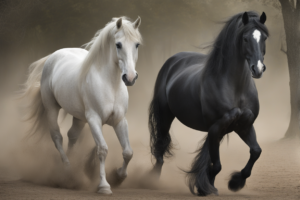
A Shire is the bigger horse by a long way. Most grown Shire stallions stand around 17.2 hands and weigh close to a ton, while the average Friesian stands 15.2 to 16 hands and weighs a little over 1,300 pounds. The Friesian is always black. The Shire might be black, or bay, brown or grey.
Jack here. That’s the short answer, and it’s the one you’ll find on every breed chart. Here’s the part the charts leave out: these two were bred for different jobs, and that job still shows up in your hay bill, your trailer and the way the horse moves under you. So if you’re standing at the barn rail looking at a big black horse and wondering which one it is, or which one to buy, let’s go through it the way I’d look at one in person.
A Shire Stands Half a Foot Taller
Start with the measuring stick. I’ll be straight with you, the gap is bigger than photos make it look.
The Friesian Horse Association of North America says a Friesian stallion has to reach at least 1.60 meters, about 15.3 hands, by age four to get into the adult studbook. Mares and geldings need 1.54 meters, right around 15 hands. The average lands between 15.2 and 16 hands, and the association puts the average weight at 1,300 pounds and up.
Now the Shire. The UK’s Shire Horse Society wants stallions at 173 cm or more, which is 17 hands, and the average grown stallion stands about 178 cm, or 17.2 hands. Geldings start at 16.2 hands and mares at 16. Stallions and geldings weigh 850 to 1,100 kg, which works out to roughly 1,870 to 2,425 pounds. Over here, the American Shire Horse Association’s guideline is a little gentler: a 16.2-hand minimum for stallions and an average of 17.1.
Put an average Friesian next to an average Shire stallion and you’re looking at 6 to 8 inches at the withers. On the scale it’s often 600 pounds or more. That’s a whole extra pony’s worth of horse.
And the record book belongs to the Shire. A gelding named Sampson, foaled in 1846, is thought to be the tallest and heaviest horse on record: over 21.2 hands and an estimated 1,524 kg, about 3,360 pounds. Nobody’s asking you to buy that one, thank goodness. But it tells you what the breed can do when it grows.
Black Is a Rule for One and a Choice for the Other

Here’s the quickest way to tell them apart at a show (and the one sellers hope you skip). A studbook Friesian only comes in black. FHANA says the shade can run from true black to a very dark brown or black-bay, and plenty of them look rusty when they’re shedding or sun-bleached in August. The only white marking allowed on a studbook horse is a small star.
Shires get a whole menu. Stallions can be black, bay, brown or grey. Mares and geldings can add roan to that list. In the UK a Shire stallion can’t be chestnut, but the American association lists chestnut, or sorrel, as a rare color it’ll take. Some white on a Shire is fine, though the standard frowns on a lot of it. On a studbook Friesian, anything past that small star is out.
So if a seller shows you a black horse with four white socks and a wide blaze and calls it a purebred Friesian, ask to see the papers. Honestly, that horse is more likely a cross, or a Shire, or something else big and dark. Nothing wrong with any of those. You just want to know what you’re paying for.
Both Wear Feathers, and Both Hide Trouble Under Them

Feathers are the long hair that hangs off the lower legs, and both breeds have them. They’re half the reason folks fall for these horses in the first place.
The Shire standard on both sides of the Atlantic asks for feather that’s fine, straight and silky. It didn’t always look like that. Clydesdale blood went into the Shire in the 1950s and 1960s, and it turned a mass of coarse hair into the silkier feather you see today. A Friesian’s feather is there too, along with that thick mane and tail it’s famous for.
Pretty as it is, feather is also a hiding place. Heavily feathered draft breeds, Shires among them, can get a slow, ongoing leg disease called chronic progressive lymphedema, or CPL. It shows up as swelling, thick crusty skin and lumps on the lower legs. Some reviews list Friesians among the breeds it turns up in as well. The sores sit right under the hair, which is why they get missed for months.
There’s no cure, and the research on the cause is still unsettled. What owners can do is look. Part the feather and check the skin every week, keep the legs dry, and if you find swelling, scabs or bumps, call your vet. Don’t treat it off a forum post. This is a vet job from the first day.
One Was Bred to Move, the Other to Pull

Honestly, this is the difference I’d want you to feel before you buy.
The Friesian is counted as a light draft, and the Dutch have kept a studbook for it since 1879. Knights rode its ancestors into battle. In the 1800s it pulled carriages and ran in trotting races. Today you’ll see it in dressage and in harness, sometimes in front of a high-wheeled cart called a sjees. When the Dutch studbook judges a Friesian, FHANA says 60% of the score is movement and 40% is conformation. That tells you what the breed cares about: a high head, a big, knee-lifting trot, and a lot of presence.

The Shire is a true heavy horse, built to lean into a collar. It pulled plows on English farms, towed barges down the canals and hauled brewery wagons through city streets. Some still deliver beer. At a British exhibition in 1924, a pair of Shires was estimated to have pulled a starting load of about 50 tonnes. Nobody knows the exact number, because they pulled past the top of the gauge.
You can see it in how each one goes. The American Shire standard asks for a horse that goes with force, using both knees and hocks, and moves straight and true. That’s power, not flash. A Friesian’s trot is big and showy, and it takes some sitting. And the Friesian isn’t a jumper by trade. FHANA says plainly the breed wasn’t bred for it, even if some owners pop over a few small fences anyway.
What the Bigger Horse Costs You in Hay

Here’s the number nobody puts on the sale ad, and the first one I’d check. The University of Minnesota Extension says most horses should eat about 2% of their body weight in hay each day.
Run the math. A 1,300-pound Friesian at 2% eats about 26 pounds of hay a day. A 2,000-pound Shire eats about 40. That’s 14 more pounds every day, and over a year it adds up to roughly 5,110 pounds. Call it two and a half tons of extra hay, before you’ve bought a single bag of feed. If your bales run around 50 pounds, that’s about 100 more bales to haul up and stack.
Hay is only the start, though. A Shire usually needs a wider draft saddle or a draft-cut treeless one, bigger blankets, a bigger stall and a taller, wider trailer than most folks own. Ask your farrier about draft shoes before you buy, not after. And talk to your vet about how much to feed, since a horse in hard work or a drafty barn eats more than one standing in the pasture all day.
The Health Questions to Ask Before You Buy

Every breed has its weak spots, and in my book a good seller won’t mind you asking about them.
For the Friesian, the industry recognizes four genetic problems: dwarfism, hydrocephalus, a tendency toward aortic rupture, and megaesophagus. There are genetic tests for the first two, and the Dutch studbook DNA-tests mares for them unless both parents already tested clear. So ask for those results. Friesians are also one of the breeds that can get a muscle disorder called PSSM.
For the Shire, ask about the legs, and about CPL in the horse’s family if the seller knows. Look under the feathers yourself.
For either one, get a pre-purchase exam from your own vet, not the seller’s. I’d never skip that on a horse this big. It’s the cheapest money you’ll spend on the whole deal, and if teeth are part of the question, my vet would tell you to bring in the equine dentist too.
How Rare Each One Is

You’d think the bigger, older working breed would be easier to find. It’s the other way around.
FHANA counts more than 45,000 Friesians registered worldwide, about 8,000 of them in North America. That’s a lot, considering the breed had vanished from this continent entirely and didn’t come back until 1974.
Shires went the other way. At their peak there were over a million. Then tractors and trucks took their jobs, and by the 1960s they were down to a few thousand. In the US only 25 were registered in the whole of the 1950s. Numbers have climbed since, but the Rare Breeds Survival Trust still lists the Shire as at risk, and the Livestock Conservancy in the US lists it as critical. So expect a longer search, and maybe a long drive.
Which One Fits You
Here’s my hot take. Pick the horse for the hay bill and the trailer, not for the photo. Both of these horses are gorgeous, and both get called gentle giants for good reason. That part’s easy. The hard part is the barn you already have.
If you want to ride dressage, drive, or just turn heads on a trail ride, and your trailer and stalls are a normal size, the Friesian makes more sense. If you’re a taller or heavier rider who wants a steady, slow horse, or you want to drive or log, and you’ve got room and hay to spare, look hard at a Shire.
Either way, ride a few of each before you decide. You’ll know inside of ten minutes whether that big Friesian trot is fun or just bouncy for you.
If you’re still comparing, I’ve put the Friesian next to a few other breeds too: the Friesian vs the Percheron, the Friesian vs the Clydesdale and the Friesian vs the Friesian Sport Horse. And if rider weight is part of your question, here’s my look at the breeds that carry heavier riders.
Happy trails, y’all.
A Must-Read:
Andalusian vs Lusitano: How Do These Iconic Horse Breeds Compare?
Andalusian vs Castilian Horses: Which Spanish Breed is Right for You?
Andalusian vs PRE Horse: What's the Difference?
Finally Figured Out the Lowdown on Andalusians vs Arabians
The Unique Traits of Friesian & Friesian Sport Horse : Grace in Motion
Distinctive Hooves: Friesian vs. Percheron – Unraveling the Distinctions