
Horses roll because it feels good. It also does a job: a roll scratches the spots a horse can’t reach, loosens old hair and rubs off dried sweat, and it leaves a layer of dust on the coat when it’s done. Down, over, up, one big shake and back to grazing. That’s about as normal as horse behavior gets.
So when you’ve spent a whole morning scrubbing a gray horse for a show and he walks straight to the one bare patch in the paddock and drops? He isn’t spiting you. Probably.
But there’s a reason I think every owner should watch a few rolls closely. Rolling is also on the vet schools’ list of colic signs, and the better you know what an everyday roll looks like, the faster the other kind jumps out at you. I went and read what researchers have actually counted (more than I expected, honestly), and I’ll tell you what you’ll see at the barn and where the line is for picking up the phone.
One thing first. HorseRoots is written by a small team, and we aren’t vets. If a horse’s rolling worries you, call your vet.
It’s Mostly a Back Scratch

Look at the mare in that photo, flat on her back with her feet in the air and her head stretched out in the sand. That’s a horse having a fine afternoon.
Nancy Diehl, a veterinarian who answers behavior questions for The Horse, files rolling under self-grooming and comfort behavior. Her short list of reasons is to scratch the back, to help shed a winter coat and to dust-bathe. The researchers keep landing in the same spot. Three of them watched 43 horses on pasture for 7 hours a morning (3 a.m. to 10 a.m.) over 4 days, and they called the roll a horse often does before it stands up “a kind of comfort behaviour.” That study came out in Applied Animal Behaviour Science in 2007, and I’ll come back to its numbers further down.
Now think about where a horse itches. The withers. Along the spine. Right under the mane. A horse can nibble its own flank and rub its face on a foreleg, but on its own it can’t get to the middle of its back.
The ground can.
After a Bath or a Hard Ride, It Heads for the Dirt
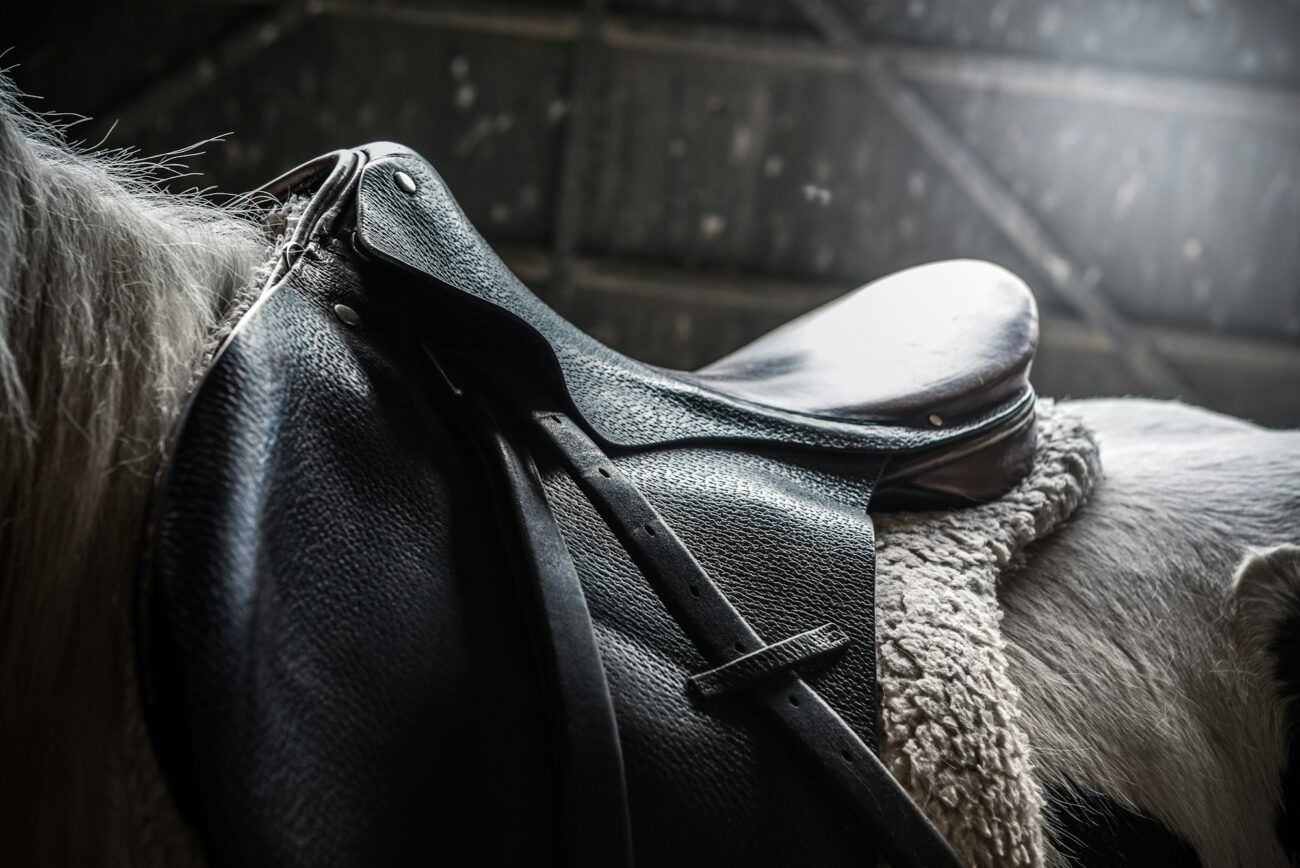
Here’s the one everybody asks me about. You hose the horse off, scrape the water away, turn him out, and he’s rolling before you’ve coiled the hose.
That isn’t just your horse being contrary. A 2021 study from Brazil, in the journal Behavioural Processes, looked at rolling in horses and mules after different amounts of work. The horses often rolled after hard exercise and after a bath, whatever the weather was doing that day.
Dr. Diehl’s answer to the bath question is that a horse rolls afterward for the same reasons it rolls any other time. My own guess (and it’s only a guess) is that a clean, damp coat just feels wrong to a horse. A roll dries the hair and puts the dust back where he likes it.
Same story after a long ride. After 2 hours on the trail, a saddle and a thick pad like the ones in that photo have pressed the hair flat the whole way, the girth too, and there’s sweat drying under all of it. Pull the tack and a lot of horses want a good roll before they want their hay.
Got a show in the morning? Honestly, there’s no trick I know of. Let the horse dry all the way before turnout, or keep him in on clean bedding overnight, and have a curry comb ready at dawn. Here’s what goes in a horse grooming kit and the order I’d use it in.
Dirt May Work Like Sunscreen and Bug Spray
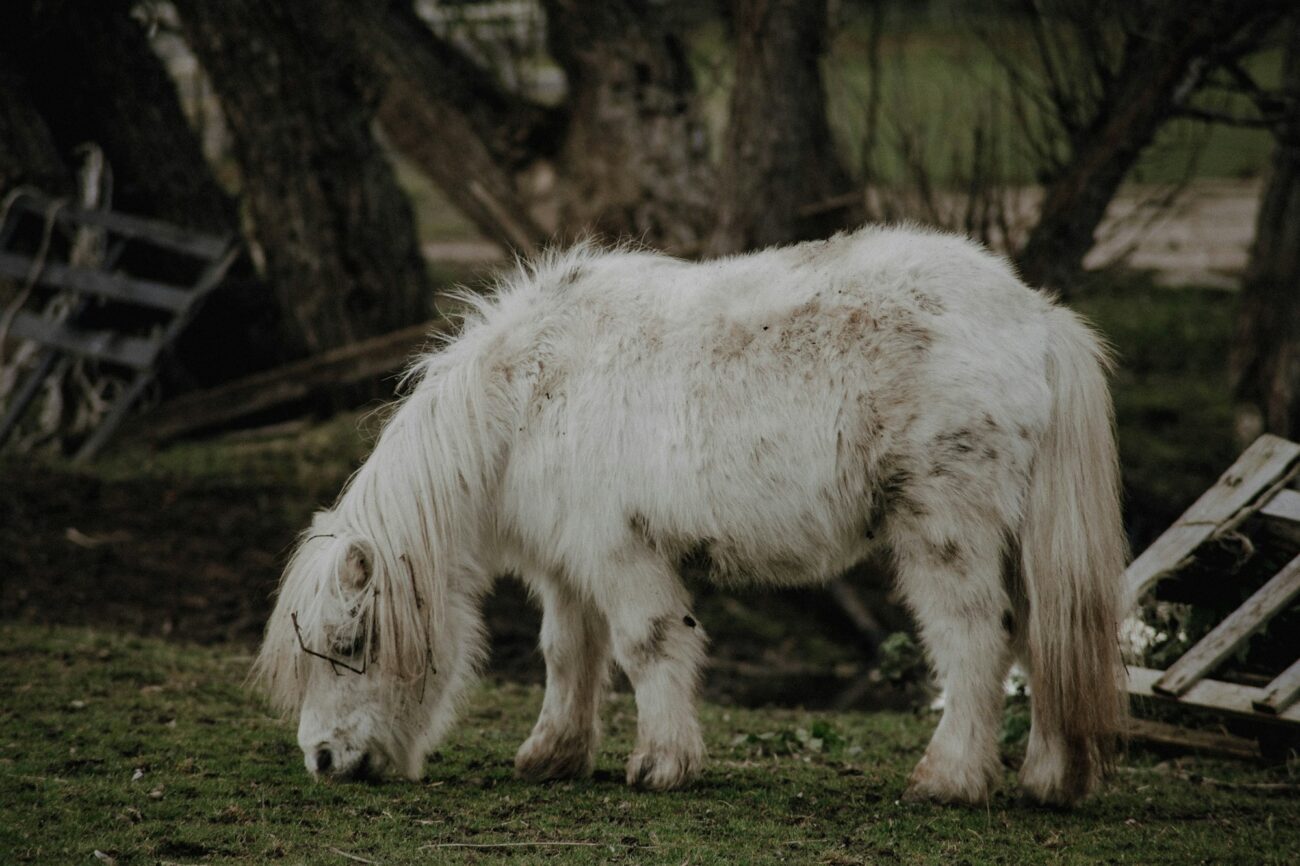
Anybody with a white or gray horse knows the look of this pony: down in the dirt at some point today, and wearing it on the side, the belly and every leg.
Behaviorists have a theory about all that dirt. The dust and mud left on a coat may act as a sunscreen and keep some insects off, and a mud roll on a hot day may cool a horse down a little. Notice I said theory. Nobody has proved it, and The Horse puts it as a theory, not a finding.
It’s a reasonable one, though, and it’s why I don’t fret over a dusty horse in the pasture. A dusty horse is a horse that’s been doing what horses do. Just brush him off before the saddle goes on. Grit trapped under a saddle pad rubs, and a sore spot under the saddle can sour a horse on being ridden for weeks.
Spring is the other big rolling season. When the winter coat’s coming out in clumps, the ground is the biggest curry comb a horse owns.
Dry Dirt Beats Mud, and Snow Comes Last
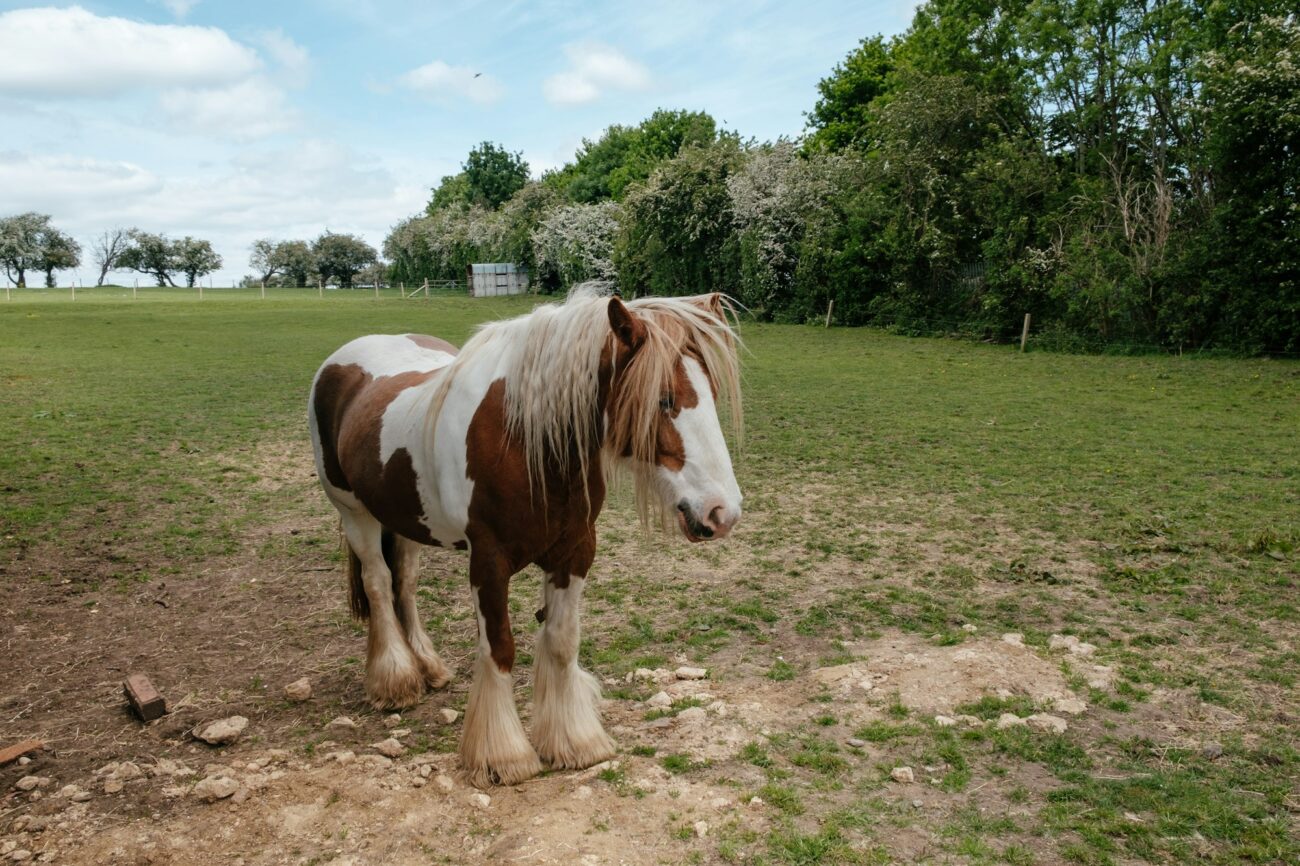
Horses are picky about where they roll. A student study at the Swedish University of Agricultural Sciences watched 12 horses for 2 hours a day over 9 days, right after they were turned out in groups of two or three. On dry ground, 11 of the 12 horses rolled. On wet ground, 8 of them did. On snow, just 3.
The same study logged 53 rolls, and the average one lasted 29.2 seconds. Every horse rolled within 60 minutes of turnout. Most of the rolls were on one side, not all the way over.
Wet ground had a twist: fewer horses rolled on it, but the rolls they did there lasted the longest.
Twelve horses is a small study, so I hold it loosely. Still, look at the bare, scuffed patch at this cob’s feet. Grass paddocks wear spots like that by the gate and by the water trough, and very often wherever the herd likes to get down and roll. If your horse’s favorite spot is a mud hole, a load of sand in a dry corner gives him a better choice.
A Blanket Makes the Roll Last Longer
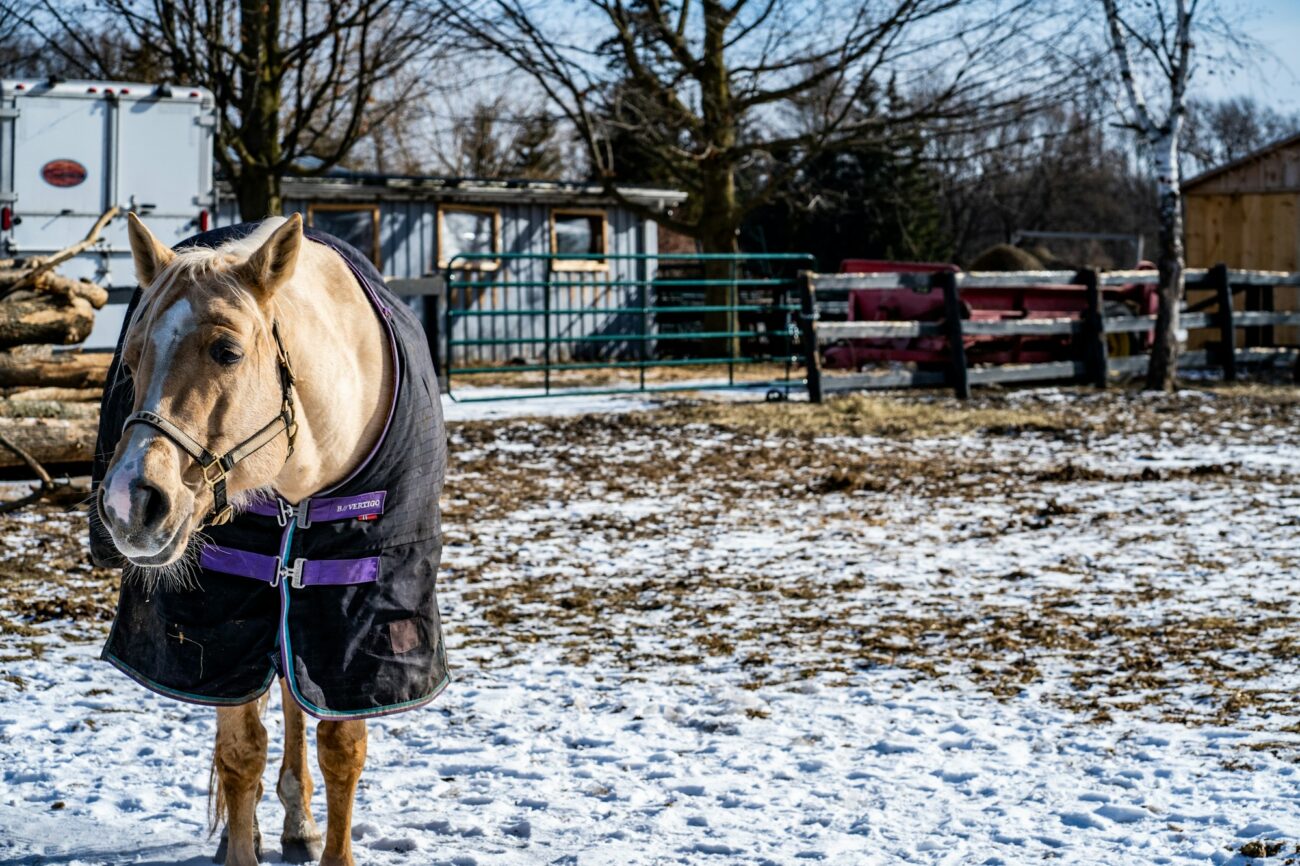
If your horse lives in a blanket all winter like this palomino in the snow, here’s a curious one. A 2024 study at the same Swedish university put 12 horses through rolling tests of 15 minutes each, once wearing a blanket and once without.
Without blankets the horses rolled 9 times. With blankets, 12. The bigger change was the length: the average roll went from 15.55 seconds bare to 28.43 seconds blanketed, nearly twice as long.
The author’s best guess is that a blanket keeps the dust and grit from reaching the coat, so the horse doesn’t get the feel it’s rolling for and keeps at it. She’s careful to say more research is needed. An earlier student study there (2015) tried the same question and had too little data to call it either way.
What I take from it is simple. Check the straps. A horse that rolls longer in a blanket is twisting that blanket harder, so the belly straps and leg straps need to fit snug enough to keep it where it belongs. And on a mild, dry day, I’d give him a few hours bare so he can have a proper roll. Here’s when a horse needs a blanket in the rain and when he doesn’t.
One Goes Down, the Rest Want a Turn
Plenty of horse folks swear rolling is catching. One goes down in the sand, and before long the next one is sniffing the same spot.
Turns out mules are even fussier about it. In that 2021 study, the mules more often rolled in the same spot and went all the way over in full spins. The horses more often pawed and sniffed the ground first, rubbed their heads and necks on it, and rolled only partway to each side.
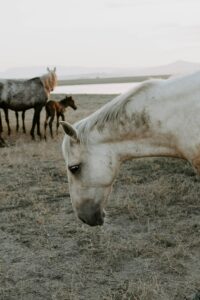
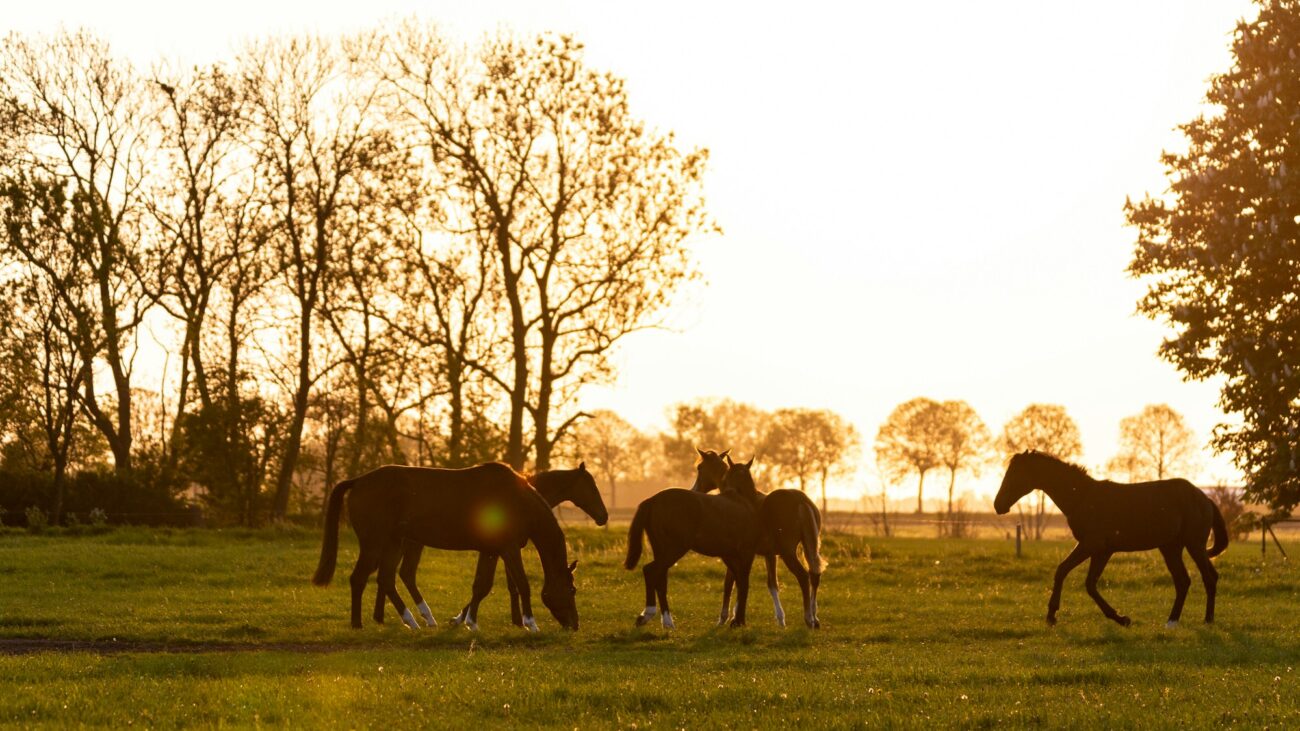
And here’s how I read a roll out in the open. It’s my reading, not a study’s. A horse on its back can’t run from anything, so a horse that lies down and rolls in the middle of the pasture, with the herd grazing around it like the bunch in this photo, is a horse that feels safe right where it is.
What a Normal Roll Looks Like
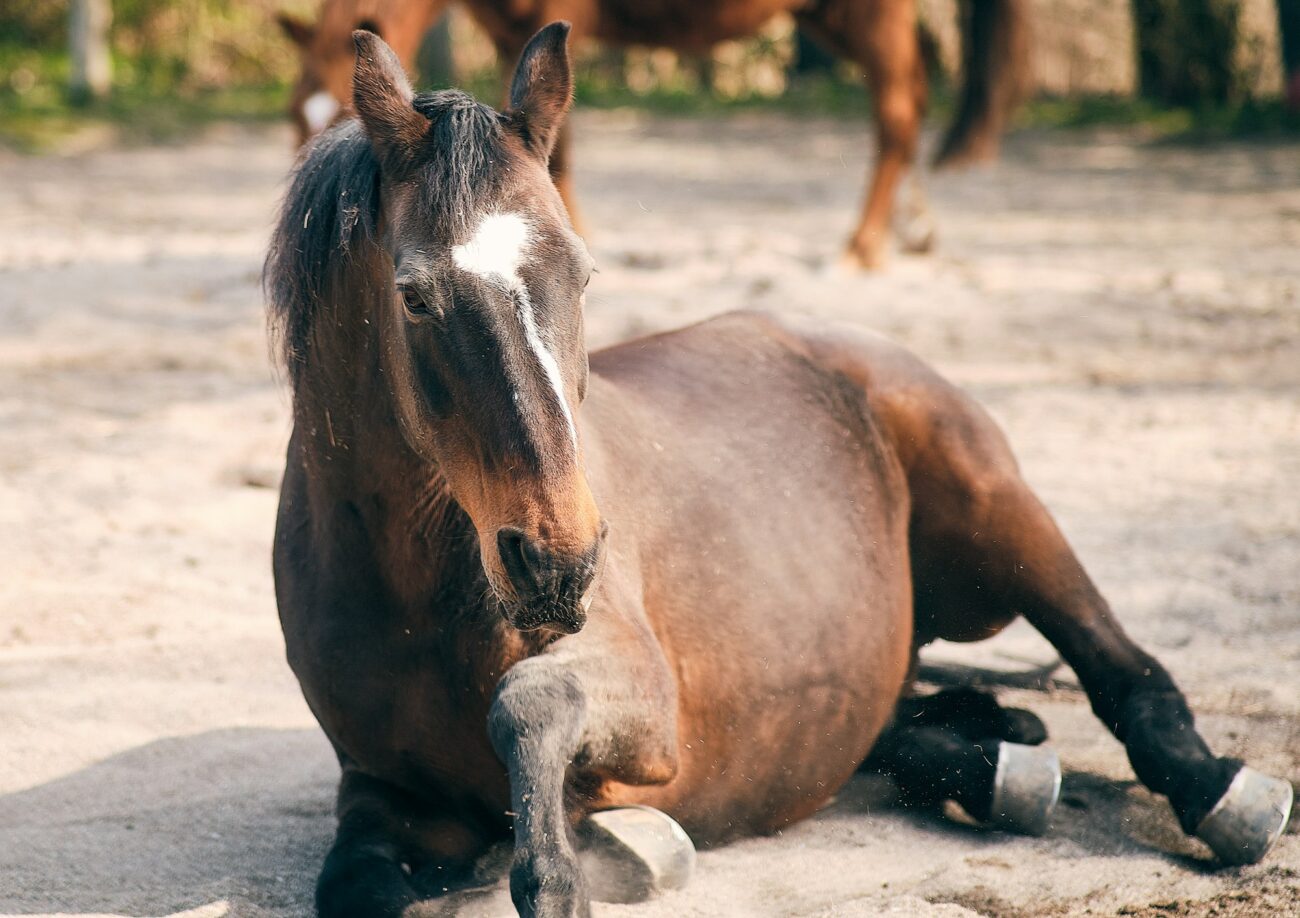
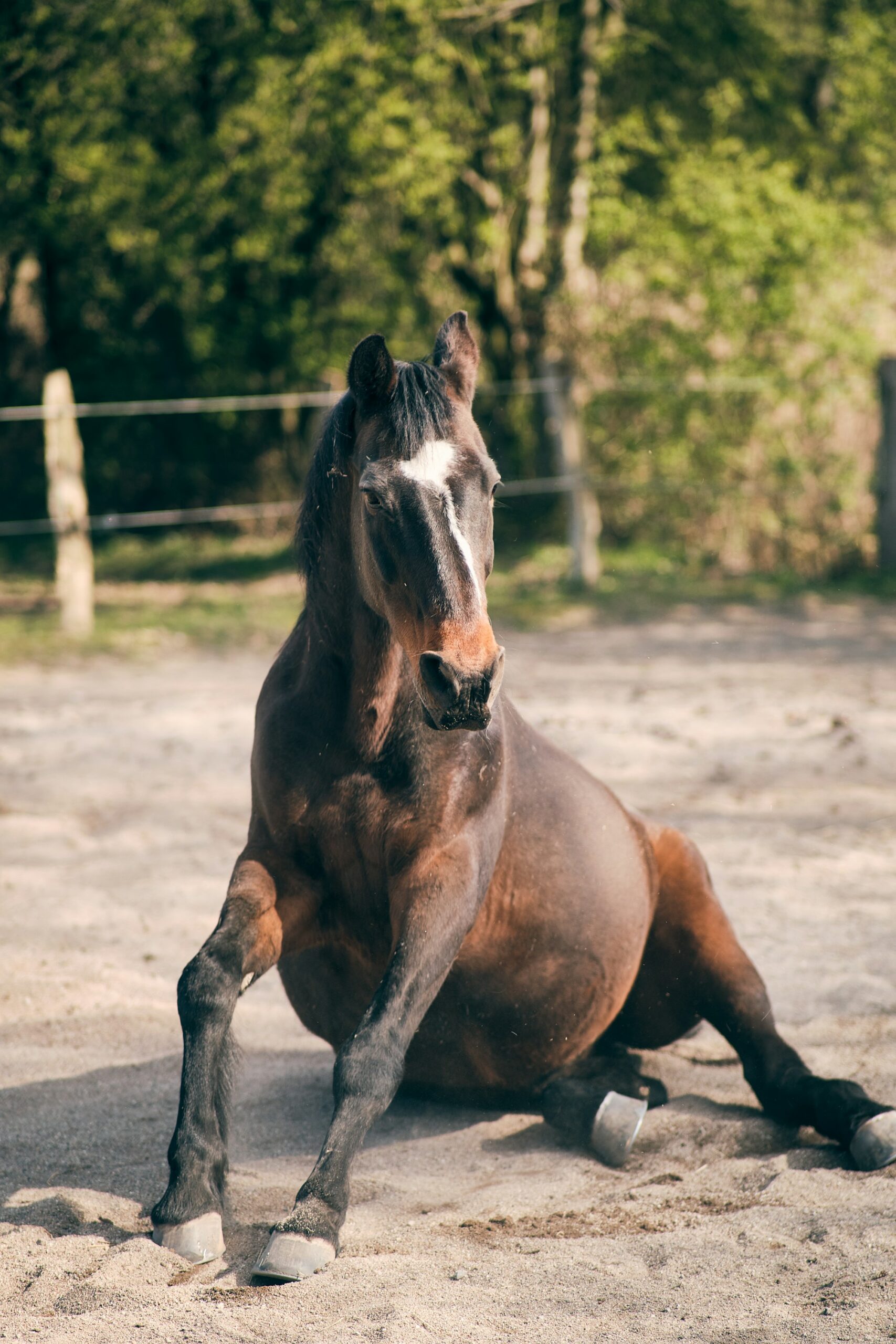
Here’s the everyday version, start to finish. The horse walks around with its nose down, sniffing. It may paw at the spot or turn a circle. It folds its front legs, goes down, rolls onto its side and maybe over its back. Then it rests on its chest for a moment like the mare in this photo, puts its front legs out and pushes up. Last comes the shake, from the ears back.
That 2007 pasture study measured how far horses went over: anywhere from 45 to 180 degrees. The ones that went all the way over, the full 180, always came back to the side they started on before they got up.
It also found that a roll is often just part of getting up. Of the 41 horses the researchers saw rise, 25 rolled at least once. Of 135 times a horse got up, 41 came right after a roll. That’s 30.4 percent, or about three times in every ten.
So a roll or two and a good shake is normal. A horse that goes down, gets up and goes down again is a different story.
When Rolling Means Call Your Vet
Rolling is a classic colic sign. A page from the Western College of Veterinary Medicine lists it with sweating, pawing, watching the flank and lying down. A milder case may just look dull and not interested in food, and some horses curl a lip or stretch out like they’re about to pee.
The difference is the pattern. A comfortable horse rolls, gets up, shakes and goes back to the grass. A horse in pain goes down again. It paws, it looks back at its belly, it won’t eat.
If you see that, call your vet now, not after lunch. While you wait, that same vet-school page says don’t give any medicine unless your vet tells you to, because a painkiller can hide the very signs the vet needs to see. Your vet may ask you to walk the horse by hand to keep it from rolling. Do what they say on the phone.
I’m not going to tell you how to sort one kind of colic from another. That takes an exam.
Give Them Room So They Don’t Get Cast
A horse that rolls too close to a stall wall can end up cast: stuck on its side or its back with its legs against the wall, without the room it needs to get up. World Horse Welfare says it happens mostly in stables, but horses can get cast under field fencing too. It treats a horse found down as an emergency, and so should you.
If it happens, call your vet and get experienced help. Some cast horses lie surprisingly still and then panic once they’re up; others kick and thrash, and a person standing in the wrong spot gets hurt. Don’t try it alone.
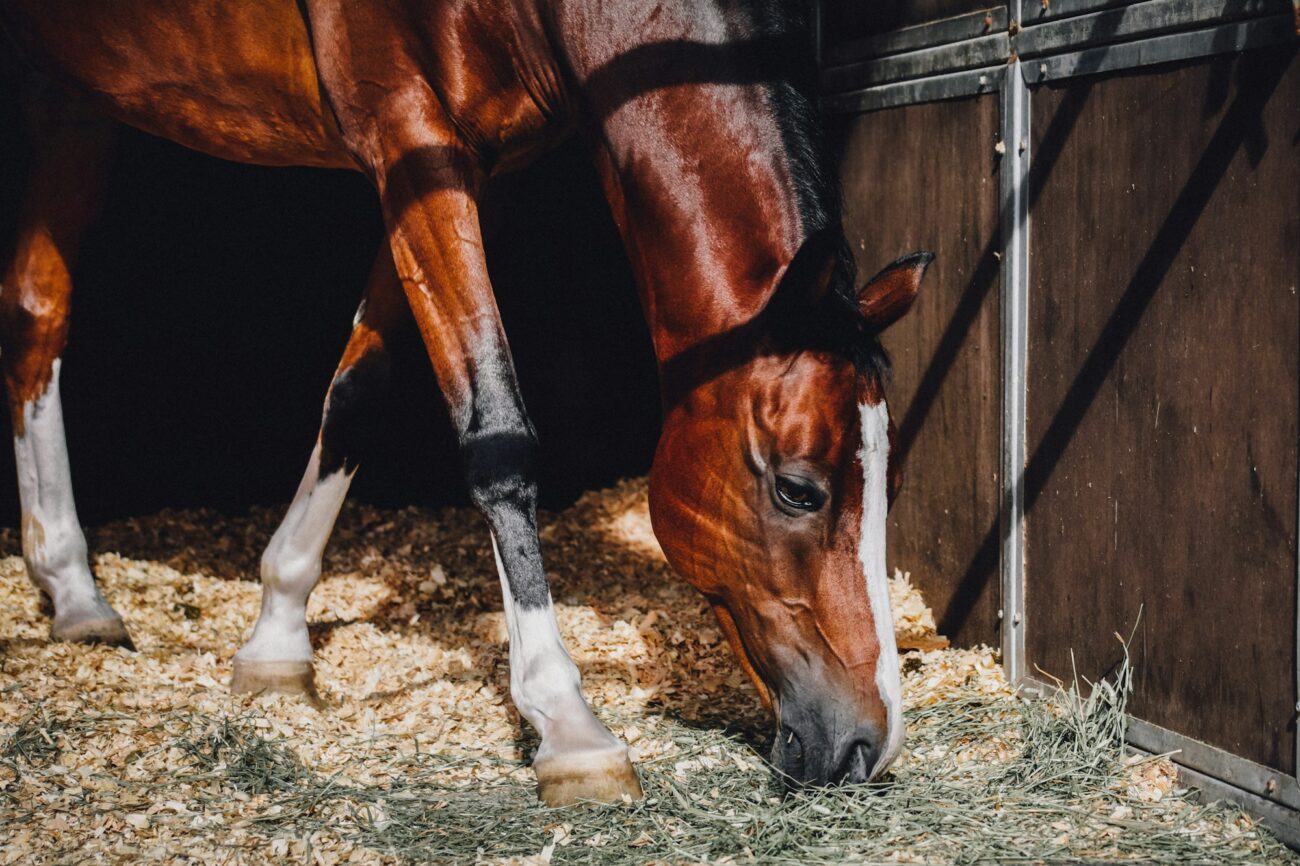
Prevention is mostly room. A stall like this one, with a deep bed of shavings and space to lie flat, is the start. World Horse Welfare also mentions anti-cast strips along the stable walls, or living out with an open-fronted shelter. Here’s more on why a stall needs bedding in the first place. Plus one more thing worth knowing: a horse that gets cast again and again is telling you something. World Horse Welfare says those horses often have an underlying problem, like pain in the muscles or joints, or a stable that’s simply too small for them. That’s a job for your vet, not for a thicker bed.
So let him roll. Pick the dried mud out of his mane, brush the dust off before you saddle up and keep half an eye on the pattern. Happy trails, y’all.