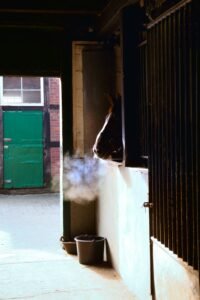
To measure a horse for a blanket, run a soft fabric tape from the center of the chest, across the point of the shoulder, to the center of the tail. Read it in inches. That number is the size to try, so a horse that tapes 76 inches tries a 76. Then pick the weight by coat and weather: a sheet has no fill, a lightweight about 60 to 100 grams, a medium 150 to 300 and a heavy 300 or more.
Jack here. HorseRoots is written by a small team, and we aren’t vets. A rub that breaks the skin or a horse that won’t stop shivering is a call to your vet, not to a tack catalog.
Blanket season sneaks up on y’all every year. One cold snap in November and the whole barn is digging through the tack room for last year’s turnout, which, honestly, fit a different horse.
First, Does Your Horse Even Need One?

Plenty of horses don’t. Maine’s bulletin says horses that are used to cold winters and left in their natural coats generally need very little blanketing, as long as they’re in good body condition and have enough feed and fresh water all the time.
Rutgers is blunt about it: there are no scientific rules for what temperature calls for what blanket. The closest thing to a number comes from studies in beef cattle. An animal with a full, dry winter coat stays comfortable down to about 18°F. Wet, clipped or still in a summer coat, that line jumps to 59°F. Rutgers says horses are likely similar, which is a fair hedge.
Here’s the test I like best, because you can do it from the gate. Look at the snow on your horse’s back. If it’s sitting there in a little white blanket of its own, the coat is holding the heat in. If it’s melting and the hair underneath is getting soaked, your horse is losing heat.
So who usually does need one? Clipped horses, for starters. Maine also flags horses with a body condition score of 4 or below, hard keepers, older horses that don’t grow the coat they used to, winter foals, and any horse that just moved up from a warm climate. That last group may take 1 to 2 winters to adapt.
Shelter matters as much as fabric. Rutgers says horses in a shelter keep up to 20% more body heat than horses left out in the open. And when it’s cold, add hay, not grain, because the fermenting hay in the gut is what makes the heat. Our post on how cold is too cold for horses to be out goes deeper on that side of it.
Grab a Sewing Tape and a Helper

You don’t need anything fancy. Rutgers says a flexible tape is the tool, and the kind used for sewing is best. Maine adds that a piece of string works fine too, and you can hold it against a hardware-store tape afterward.
Skip the weight tape that came with your feed bags. It wraps around the barrel behind the elbows, so it measures girth. A blanket size is a length, front to back, and those two numbers have nothing to do with each other.
A helper makes this a two-minute job instead of a rodeo. One of you holds the horse and the end of the tape at the chest, and the other walks the tape back. Dover’s guide says to stand your horse square on level ground first, and that part matters. A horse resting a hind leg or standing with his front end uphill on a slope will give you a number that’s off by an inch or two.
How to Measure, Step by Step

Start in the middle of the chest, right where the base of the neck meets it. That’s the spot Dover names, and Maine says the same. Then bring the tape back across the point of the shoulder, the bony bump at the front of the shoulder, and keep it level along the side of the body.
Where you stop is where the sources split a little. Maine says stop at the center of the dock, the top of the tail. Rutgers says go straight back to the center of the thigh, just next to the tail. On most horses those two points are close, so don’t lose sleep over it.
Dover adds a choice of its own. Some folks like a turnout long enough to make a little “tent” over the tail, and some like a blanket that stops just short of it. Measure to the point where you want the blanket to end, and you’ve already decided.
Take the measurement twice. If the two numbers are more than an inch apart, your horse moved, and you get to do it a third time. Write the final number on a piece of tape inside your tack trunk lid so you’re not doing this again in March.
Turning Your Number Into a Size

Here’s the nice part. Dover’s guide says the inches translate straight into the blanket size you should try, so a 78-inch horse starts with a 78.
Rutgers gives a rough map of where most horses land. Ponies usually measure in the 60s, average horses somewhere in the 70s, and bigger warmbloods and drafts in the 80s. If your quarter horse tapes at 64, measure again before you order anything.
Some companies only make even sizes, like 76, 78 and 80. Rutgers says to round to the nearest even number when that happens. Land on an odd number right in the middle, and I’d try both sizes if the shop lets you, because the fit check in the next section is the real judge.
And brands run different. Maine compares it to pant sizes, which is about right: two blankets both labeled 76 can sit very differently across the shoulders. A horse with big shoulders and a narrow back end might need a different cut, not just a different size.
Checking the Fit Once It’s On

Put it on in order, front to back. Dover says chest closures first, then the belly straps (the surcingles), then the leg or tail straps. That way a horse who spooks halfway through is wearing a blanket that’s buckled at the front, not one hanging off his hip.
Now slide a flat hand under the blanket at the point of the shoulder and again at the withers. Maine says that if it’s hard to get your hand in there, loosen the chest straps or go up a size. Tight spots in those two places turn into rubs and sores, and Rutgers says a blanket that’s too big can rub the withers and shoulders just as badly.
The belly straps cross under the middle of the belly and buckle on the opposite side. Maine wants room for three fingers between belly and strap, but not so loose a hind hoof could get through. Leg straps get a little droop, never so low that a hoof catches. Turn the clip openings in toward the horse, too, so they don’t snag on a hay bag.
Taking it off, go backward: leg straps, belly, chest last. One small trick from Maine that I love: a dryer sheet rubbed on the blanket cuts the static shock when you peel it off in January.
Sheet, Light, Medium or Heavy: Picking the Weight

Blanket weight is grams of polyfill inside the shell. Maine’s table puts a stable sheet, a rain sheet and a liner at 0 grams, a lightweight at 60 to 100, a medium at 150 to 300 and a heavy at 300 or more. Rutgers lands in the same place, with mediums around 200 grams and heavies around 300.
Two more labels are worth a look. Turnouts need to say waterproof, because a roll in the snow or a cold rain on a water-resistant blanket just makes a wet horse. And denier is the toughness of the shell weave. Maine says a 1200D blanket will be stronger and likely last longer than a 600D one, which counts if your horse’s pasture buddy likes to chew straps.
For the weather itself, Maine’s guide splits horses into full coats and clipped coats. A full-coated horse needs nothing at 40°F and up, maybe a rain sheet between 25 and 39°F if it’s wet, a light or mid between 15 and 24°F, and a heavy from 0 to 14°F. A clipped horse is a step ahead the whole way and wants a heavy, a liner and a hood once it drops below 15°F.
Treat that chart as a starting point. Wind chill counts, and a horse in a drafty run-in isn’t standing in the same weather as the thermometer on your porch. If the forecast says 10°F tonight and 40°F tomorrow, Maine says take the blanket off in the morning so the coat can fluff back up.
The Mistakes Behind Most Rubs and Shivers

The big one is a wet horse under a blanket. Maine puts it in capital letters: never blanket a wet horse. Towel him off or use a blow dryer first. Rutgers points out that wet trapped under a blanket makes a colder horse and can set up a skin fungus. A wool or fleece cooler wicks the water out while he dries, and then the blanket goes on.
Second is the blanket that stays on through a warm afternoon. A horse sweating under there is too warm, so go lighter. A horse that’s shivering needs more. Rutgers says to check a short while after you blanket, and turns out that one look catches most of it.
Third, know what you’re signing up for. Rutgers says blankets worn all the time flatten the coat so it insulates less, and once you start, expect blanket duty the whole season.
And last, the one I’d tape to the barn door. Don’t blanket a horse and forget him. Rutgers says to pull the blanket at least once a week for a good grooming and a look, because a blanket hides weight loss, skin infections and rubs. Our horse grooming kit guide covers the brushes for that weekly groom, and if it’s rain more than cold where you are, read do horses need blankets in the rain next.
A raw spot, hair rubbed off down to skin, or a horse who flinches when you touch under the blanket line is a call to your vet. Now go find that tape measure before the first cold snap does. Happy trails, y’all.
A Must-Read:
Can Horses Live in the Jungle?
Horse First Aid Kit Checklist: What to Keep in the Barn and Trailer
Should a Colicky Horse eat hay?
What are the signs of gas Colic in Horses?
Salt or Electrolytes: What's Best for My Horse?
What is a Natural Electrolyte for Horses?