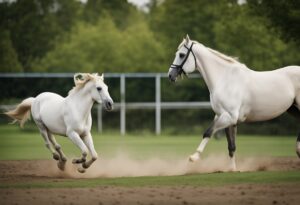
Horses wear blinders so they look where they’re going instead of at everything beside and behind them. The leather or plastic cups sit next to each eye and cut off part of the side view, and most of the rear view with it. Racehorses wear them to keep their mind on the race. Carriage horses wear them so the cart rolling along behind doesn’t spook them.
It’s Jack here. Y’all have probably seen blinders on a Derby horse, or on the horses pulling carriages around a city park, and wondered why the horse in your own barn goes without. So I went through the racing rulebooks and the harness books to get it straight. The answer starts with how a horse sees.
Short version? A horse sees nearly all the way around. That’s great for spotting a predator and lousy for keeping its mind on the job in front of it.
A Horse Sees Almost All the Way Around

Look at where your horse’s eyes sit. They’re on the sides of the head, and they’re big (among the largest of any land mammal). That setup gives a horse a field of view of about 350°, which is pretty much a full circle.
Only about 65° of that is binocular, the strip in front where both eyes overlap and the horse gets real depth. The other 285° is monocular, each eye watching its own side. That’s a prey animal’s design. Something moving out at the edge of the picture is usually the first sign of trouble, and a horse is wired to react to that motion before it can make out what’s moving. So the edges of the view aren’t sharp, but they’re on high alert.
There are two blind spots. One is a cone right in front of the face that comes to a point about 3 or 4 feet out (roughly 90 to 120 cm). The other runs straight back from the head, over the back and past the tail, when the horse is looking straight ahead. That’s why you speak up before you walk up behind one.
Now picture a racehorse in a field of a dozen others, a crowd hollering along the rail, a whip flashing at its side. Or a carriage horse with a big wooden box clattering along right behind it. You’d be looking around too.
What Blinders Block, and What They Leave Alone

Blinkers, blinders, blinds, winkers. Same idea, different barns. Americans mostly say blinders, racing folks say blinkers, and winkers is another name you’ll run into. All of them limit how much a horse can see, blocking the view to the side, to the rear, or both.
What they don’t do is cover the eyes. A horse in blinders still sees straight ahead just fine. On a driving bridle the cups are held off the face by a stiff rolled-leather strap called a blinker stay, and the harness books say a blinker should sit centered on the eye and stand wide enough that it doesn’t touch it. When they fit right, nothing presses on the eye at all.
Here’s a bit of history I like. Keeneland’s racing glossary says blinkers were once called the “Rogue’s Badge.” That tells you what people used to think of a horse wearing them: one that couldn’t be trusted to run straight on its own. Today they’re a common piece of racing gear, and nobody’s branding the horse a rogue.
Carriage Horses Don’t Need to See the Cart

On a driving horse, blinders are the normal thing, not the odd one. The bridle on a driving harness usually has them attached to its cheekpieces. They stop the horse from seeing what’s behind it and still let it see forward, and most driving blinkers block the side view too.
Think about it from the horse’s end of the shafts. There’s a box on wheels following it everywhere it goes, rattling and creaking, sometimes with a whip sticking up out of it. For an animal built to run from things that chase it, that’s a lot to ask. Blinders take the cart out of the picture. The horse watches the road and you handle the rest.
They come in more shapes than you’d guess: round, square, D-shaped, hatchet-shaped, curved, you name it. Square is the most common. Under the leather there’s a metal blinker plate, covered in leather or patent leather (or something made to look like it). Buckles in the cheekpieces raise or lower the cups so they line up with the eye, and a buckle at the crown sets how wide they stand.
One word of caution from me. I wouldn’t pull the blinders off a horse that’s always been driven in them and head straight out onto a road to see what happens.
That’s a talk with whoever trained it to drive.
Racehorses Wear Them to Keep Their Mind on the Race

Racing blinkers are built a little differently. They’re a hood that slips over the head and goes on under the bridle, with plastic cups on each side of the eyes. Plenty of trainers believe they keep a horse focused on what’s in front of it, the race, instead of the crowd and the other horses.
Ontario Racing put it about as plainly as anyone: trainers use blinkers to help a horse focus on its race. Hall of Fame trainer Todd Pletcher has said they can help keep a horse “locked in.” And you see them most on lightly raced horses, the ones still figuring out that a race means running, not sightseeing.
Now the honest part. Whether blinkers make a horse faster is something bettors argue about every weekend, and the numbers I could find were handicappers’ tallies, not science. Some horses run better in them. Some run worse. I couldn’t tell you which yours would be, and neither could anybody else until the horse runs. That’s exactly why the change gets announced.
In American racing, the stewards have to approve putting blinkers on or taking them off, and the change is printed in the official program. Illinois’ rules, for one, say the starter has to sign off before the stewards grant it, and the request has to be made when the horse is entered. So when you see “blinkers on” or “blinkers off” next to a horse’s name, somebody asked, two officials said yes, and a lot of handicappers just circled it. Plenty of bettors even think “blinkers off” matters more than “blinkers on,” which tickles me.
If you’ve wondered about the bright red masks some racehorses wear, that’s this same idea, and we covered it in why race horses wear red masks.
Visors, Cheekpieces and Shadow Rolls: The Milder Versions
Full blinkers aren’t the only choice. Racing has a whole menu, and the clearest rulebook I found for it is Racing Australia’s equipment register, because it puts a number on nearly everything.
A standard blinker cup there can’t be more than 6 cm wide (about 2.4 inches), and it has to stay open enough for the horse to see forward and off to the side. A visor is a blinker with a peephole cut in the back of the cup, so the horse keeps a slice of its rear view. Australia lets no more than 50% of the cup be cut away.
Cheekpieces, which Australians call winkers, are lambswool tubes fixed to the bridle’s cheek straps. They’re the gentle version. They take away some of the rear view, but a lot less than blinkers do. Australia caps them at 270 mm long, about 10.6 inches, and won’t let a horse wear them together with blinkers.
A shadow roll isn’t on the eyes at all. It’s a fat roll of sheepskin on the noseband that blocks the view of the ground right in front, for a horse that tries to jump shadows on the track. You’ll see one in show jumping now and then too, on a horse that carries its head too high. With the roll in the way, it has to drop its nose to see the fence.
Pacifiers look like blinkers but do a different job. They’re mesh cups that protect the eyes from dirt and stones kicked back by the horses ahead. They’re there for protection, not focus. Stewards can even order them off on a wet day, because mud clogs the mesh.
Why Most Riding Horses Go Without

Blinders show up mostly in driving and racing and only rarely under saddle. There’s a good reason for that.
When you saddle up, you’re doing the job blinders do for a carriage horse. Your hands and legs tell the horse where to go, and your voice tells it that the plastic bag on the fence is not a mountain lion. A riding horse also needs its whole view more than a racehorse going around an oval does. On a trail it’s picking its way over roots and rocks. Over a jump, it lifts its head a few strides out to size up the fence, because the fence slips into that blind spot in front of its face right before takeoff. Take away the edges of its view and you’ve taken away part of how it keeps its feet under it, and yours.
And honestly, I’d rather a riding horse see the scary thing early, look at it, and decide it’s fine. A cup that hides a flapping tarp until it’s right beside the horse gives it less time to think, not more. A surprised horse tends to move first and think later. It’s the same reason a horse would rather doze on its feet than lie flat where something could sneak up.
Before You Reach for Blinders, Check These

Every so often somebody at the barn asks me if blinders would fix a spooky riding horse. Here’s how I’d think it through before you buy anything.
A horse that’s always been a little looky usually needs miles and patient training, not new tack. But a horse that’s fussy under saddle, tossing its head or fighting the bit, needs its saddle fit and its teeth checked before anybody blames its eyes. A lot of “my horse is acting up” problems turn out to be a mouth or a saddle problem in disguise. If the bit is part of your story, our post on why horses chomp at the bit is a good place to start.
Then there’s the one that worries me.
A horse that suddenly starts spooking at things on one side, bumping into gates, or carrying its head at a funny angle has changed how it reacts to the world, and that can be a change in how it sees. Don’t cover it up with blinders. Call your vet and have the eyes looked at. That’s their job, not a website’s and not mine.
If Your Horse Wears Them, Fit Them Right

Maybe you drive, or you’ve got a horse coming off the track that raced in a hood. Either way, here’s what I’d watch day to day.
Center the cup on the eye. It should stand off far enough that it never touches the eye or rubs the lashes. On a driving bridle, the cheekpiece buckles set the height and the blinker stay sets the width. Racing blinkers go on under the bridle and fasten with buckles or clips, so check that both sides are done up the same.
Look underneath after every ride or drive. Sweat and arena dust collect under a hood. A little hair rubbed flat is a fit problem you can fix with the buckles. Swelling, a runny or cloudy eye, or a horse squinting on one side is not: take the gear off and call your vet.
New gear gets tried at home first, and racing rules expect it. In Australia, a 2-year-old or unraced horse that’ll race in blinkers or winkers together with a nose roll has to trial in that gear to the stewards’ satisfaction before it’s accepted for the race. So copy the idea. Lead your horse around in them, then work it lightly, then ask for something bigger. Let it learn that the world got a little narrower and nothing bad happened.
That’s blinders for you: a pair of cups that trade the edges of the picture for focus. Racehorses and carriage horses get the trade because they’ve got a job straight ahead and a lot going on around them. Your trail horse has you instead. Happy trails, y’all.
A Must-Read:
Where do Horses NOT Like to be Touched?
Why Does My Horse Keep Trying to Buck Me Off?
Do Horses Remember Traumatic Experiences?
The Real Deal on Why Horses Piddle on Their Chow
Why Do Horses Chomp at the Bit: 9+ Reasons You Never Knew
Rare Phenomenon of Horse Aggression Toward Foals Revealed!